
Medical Device Procurement
Know where every dollar goes, and where some shouldn’t have.
The problem
You can’t manage device spend you can’t see.
Surgical devices and implants make up about 40% of a hospital’s supply chain spend. Yet most hospitals can’t answer basic questions about it:
- Which suppliers are we spending the most with, and in which service lines?
- How much of our device spend is off contract?
- Which SKUs are billing above contract price?
- Which facilities are driving the variance?
The data exists in every bill-only, every PO and every contract. It just isn’t connected, so variances show up months later in a reconciliation, or not at all.
How Martian addresses it
1. Connect spend to the contract
Martian joins bill-only line items with your contract pricing and ERP item master. Every device dollar is tied to what you agreed to pay.
2. See spend from every angle
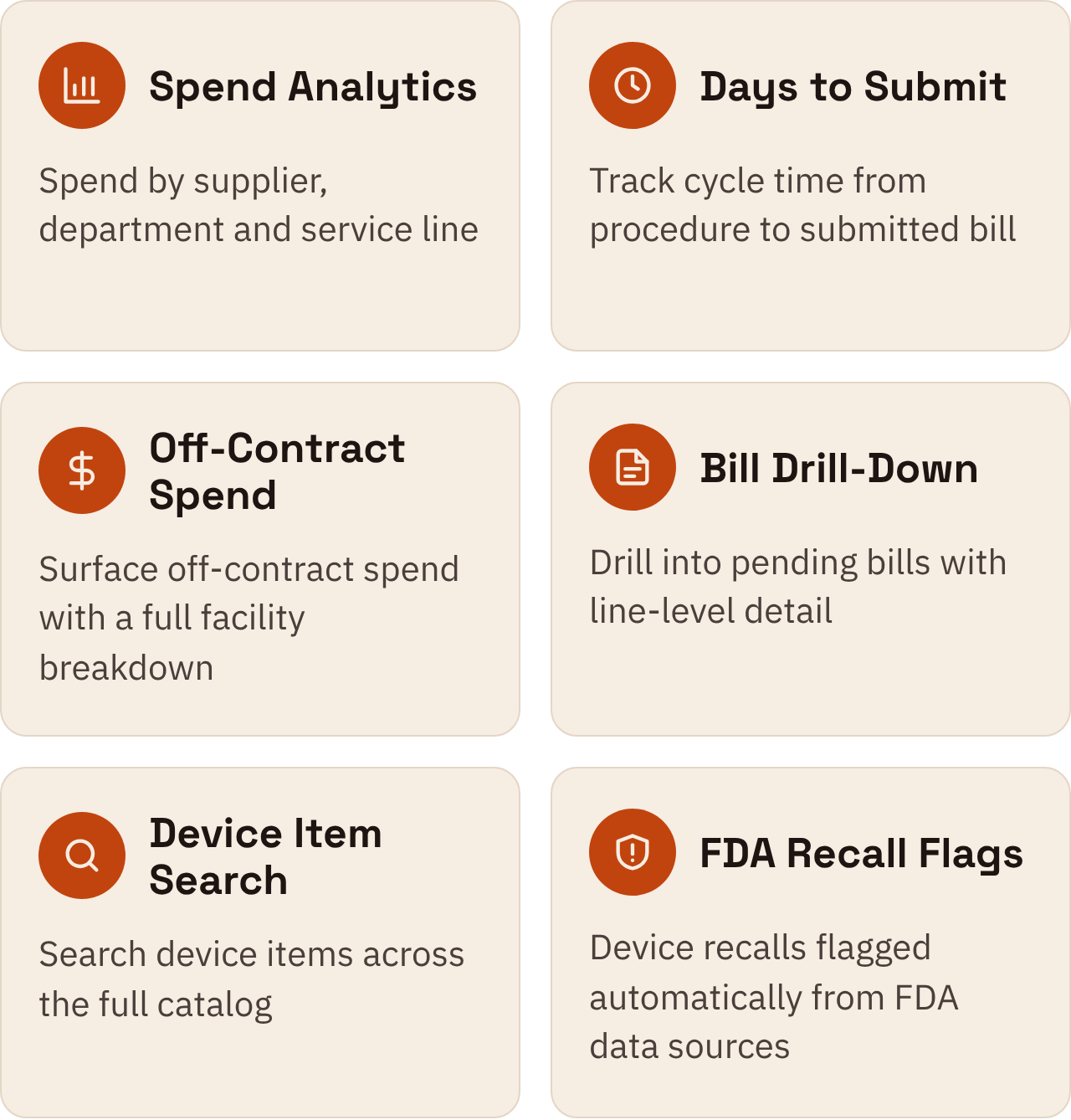
- By supplier, department and service line: where the money goes
- Off-contract spend by facility: where it leaks
- Line-level drill-down: what’s behind any number
- Device item search: any item across the full catalog
3. Agentic AI interface: Ask questions in conversation language
Ask “What did we spend on spinal implants with each supplier last quarter?” and get the answer. You don’t need SQL or a report request.
4. Get the signal, not the noise
Martian pulls out the small share of data that needs attention, such as a price variance, a new off-contract item or an FDA recall, and alerts the right person.
Results
What you’ll be able to answer
Supply Chain
Which suppliers and SKUs are off contract, and by how much?
Finance
What does device spend look like by service line, and where are the savings?
Perioperative Services
Which procedures and physicians drive implant cost variance?
Compliance
Are any recalled devices in our catalog or in recent cases?
Works with the systems you have
EMR: Epic, Oracle Health